
Massachusetts Lie Detector Class Actions: Standing and AI Screening Issues Head to Appellate Courts
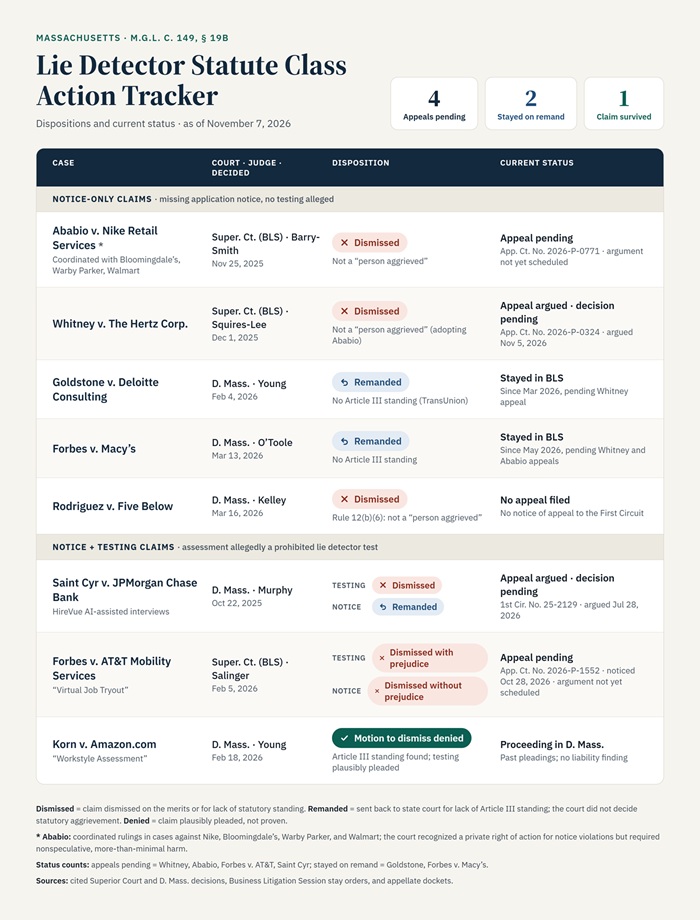
Recent decisions under the Massachusetts Lie Detector Statute, M.G.L. c. 149, Section 19B, highlight barriers to class actions challenging employment applications and screening tools. Federal courts have remanded notice-only claims for lack of Article III standing or because the plaintiffs were not “persons aggrieved” under the statute. Massachusetts’ Superior Court Business Litigation Session (BLS) has dismissed similar claims based on the same statutory grounds, which rulings are currently on appeal. Pending federal and state appeals could clarify both the injury required to pursue notice claims and the allegations necessary to challenge hiring assessments.
The Massachusetts Lie Detector Statute
Section 19B generally prohibits employers from requiring or administering lie detector tests and requires Massachusetts employment applications to contain written notice of that prohibition. It authorizes civil actions by a “person aggrieved” by a violation of subsection (2), which includes the notice requirement. Its definition of a lie detector test extends beyond conventional polygraphs to other devices, instruments, and written examinations used to assess truthfulness.
Class action claims based on the statute present two recurring theories: employers omitted the required notice, or employers both omitted the notice and administered assessments allegedly constituting prohibited tests.
Federal Courts Remand Notice-Only Claims
In Forbes v. Macy’s, Inc., Judge George O’Toole remanded the action on March 13, 2026. The plaintiffs alleged missing notices but no testing or resulting financial, physical, or emotional harm. The court concluded that the procedural violation, without downstream consequences, did not establish Article III standing.
Judge William Young reached a similar conclusion in Goldstone v. Deloitte Consulting LLP on February 4, 2026. Applying TransUnion v. Ramirez, he concluded that an informational injury without downstream consequences was insufficient. Neither court decided whether the plaintiffs qualified as “persons aggrieved” under Massachusetts law.
Statutory Standing Provides a Separate Defense
In Ababio v. Nike Retail Services, Inc., Justice Christopher Barry-Smith addressed coordinated cases against Nike, Bloomingdale’s, Warby Parker, and Walmart on November 25, 2025. He recognized a private right of action for notice violations but required nonspeculative harm exceeding a minimal or slightly appreciable injury. The notice-only plaintiffs did not qualify as “persons aggrieved.” Justice Debra Squires-Lee adopted that reasoning in Whitney v. The Hertz Corporation on December 1, 2025.
Judge Angel Kelley followed that approach in Rodriguez v. Five Below, Inc. on March 16, 2026. Unlike the jurisdictional remands, she treated statutory standing as a merits issue under Rule 12(b)(6) and dismissed the notice-only claim.
Remanded Cases Await Related State Appeals
Following remand, Goldstone and Whitney were stayed in the BLS in March and May of 2026, respectively, pending the Appeals Court’s rulings in Whitney and Ababio. Oral argument was held in Whitney on November 5, 2026; no decision has issued to date. Oral argument has not yet been scheduled in Ababio. Affirmance could strengthen dismissal arguments against notice-only claims. Reversal could permit those claims to proceed in state court despite federal jurisdictional barriers.
Testing Allegations Produce Different Results—and Another Appeal
In Forbes v. AT&T Mobility Services LLC, Justice Kenneth Salinger dismissed a notice claim without prejudice on February 5, 2026. He separately dismissed the testing claim with prejudice because allegations concerning a “Virtual Job Tryout” did not plausibly establish a purpose of detecting deception or assessing honesty. A notice of appeal was entered on October 28, 2026. That proceeding is another opportunity for appellate guidance concerning the statute’s application to hiring assessments.
Judge Young denied dismissal in Korn v. Amazon.com, Inc. on February 18, 2026. Korn plausibly alleged a prohibited “Workstyle Assessment” and use of the collected information. Judge Young found Article III standing and adopted Ababio’s reasoning that omitted notice combined with unlawful testing could cause appreciable harm.
Saint Cyr Could Shape AI Screening Claims
In Saint Cyr v. JPMorgan Chase Bank, N.A., Judge Brian Murphy dismissed a testing claim on October 22, 2025. Allegations about screening tool’s capabilities did not plausibly establish that JPMorgan used its AI-assisted interviews to assess truthfulness. He separately remanded the notice claim for lack of Article III standing.
An appeal from the decision was argued before the First Circuit July 28, 2026; no decision has yet issued. The plaintiff-appellant challenges whether the court improperly required employer-specific evidence of purpose before discovery. An affirmance endorsing that reasoning could strengthen dismissal arguments where complaints rely on generalized AI capabilities without connecting them to the employer’s use. Reversal could allow more claims to reach discovery.
Implications for Employers and Defendants
The pending state and federal appeals leave important questions unresolved concerning statutory aggrievement, federal standing, and when employment screening tools qualify as lie detector tests. Pending that guidance, employers should review Massachusetts job applications for the required statutory notice. Employers should also evaluate the purpose, operation, and use of hiring technology, particularly AI tools, biometric screening, and personality assessments.